





Gambling Addiction | Signs, Symptoms and Effects
While many people engage with gambling a few times a year at low stakes and show a balanced relationship, others face far greater difficulty. When gambling begins to interfere with wellbeing, finances or relationships, it can become deeply addictive and hard to control without support.
What is classed as gambling?
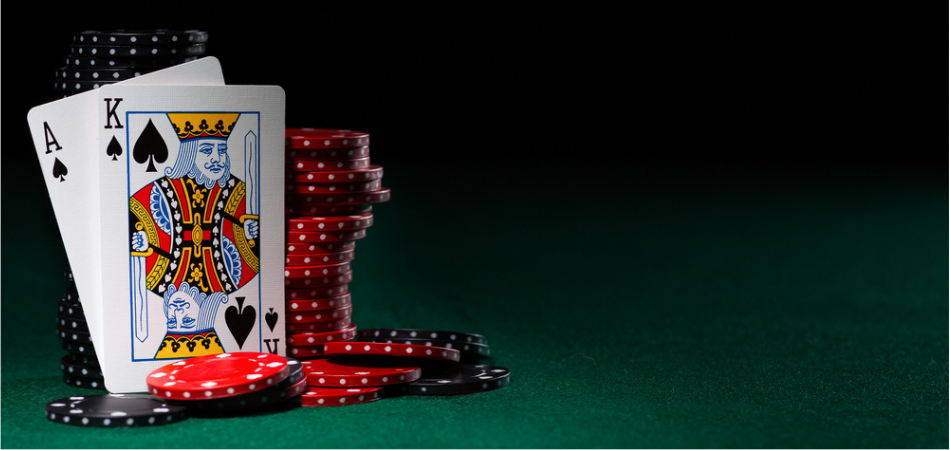
Gambling is woven into many parts of everyday life, often in ways that are not immediately obvious. Most people picture a bet on the football, a few spins on a fruit machine or a night at the casino. While those remain common examples, the modern world has introduced new forms that sit in plain sight and can be just as tempting. Because gambling is so accessible, it can feel harmless at first glance, yet these activities all share the same core feature of risking something of value for the chance of a reward.
Some common types of gambling include:
- Casino games such as roulette and blackjack
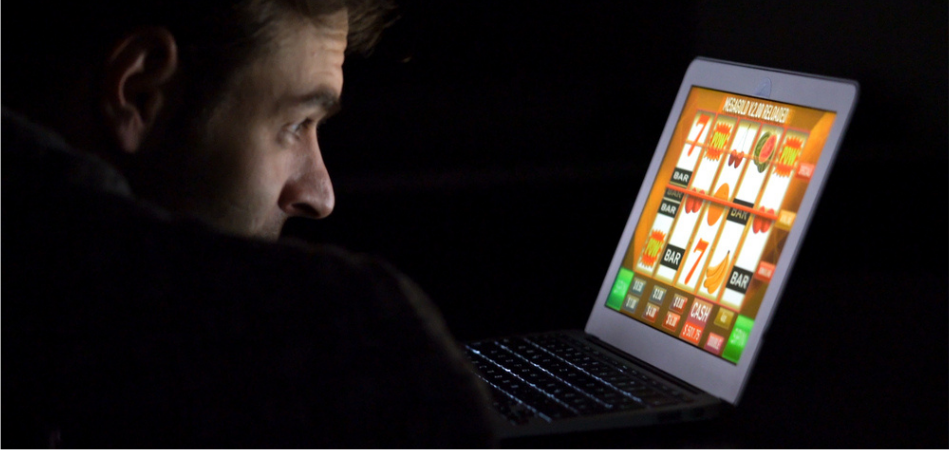
- Online betting platforms and mobile gambling apps
- Scratch cards and national lotteries
- Bingo halls and digital bingo games
- Horse racing and greyhound racing events
- Fruit machines and high-speed gaming terminals
- Cryptocurrency trading used with speculative intent
- Online auctions where escalating bids can mirror gambling behaviour
- “Loot boxes” and “mystery-box” mechanics in video games
- Collectable card packs, such as trading card games or limited edition drops
What makes gambling so addictive?
Have you ever wondered why one person can place a bet and walk away without a second thought, while another returns again and again chasing the next win? There are several factors at play that can trigger a gambling addiction, and they create a powerful cycle that can keep a person hooked for far longer than they ever intended. Understanding these can help explain how gambling can progress from occasional fun into something far more consuming.
Struggling with Gambling addiction?
Gambling in the UK
Gambling addiction is currently considered a serious public health concern within the UK. Recent government and public health data suggest that about 2.7% of British adults, representing roughly 1.4 million people, meet the criteria for problem gambling. In England alone, an estimated 1.6 million adults who gamble are believed to need treatment or support for harmful gambling habits. These figures highlight how widespread this issue has become.
Young people are increasingly affected. Research indicates that around 85,000 children under the age of 18 are now classified as having a gambling problem, which many experts find deeply concerning. Gambling harm does not only impact the individual either, as an estimated one in four people in the UK are directly or indirectly affected. Family members, friends and colleagues often feel the ripple effects.
Government data suggests that between 117 and 496 gambling-related suicides occur in England every year, demonstrating how devastating the consequences can be when gambling addiction takes hold. These statistics reinforce the need for awareness, early intervention and accessible treatment.
What are the signs of gambling addiction?
Gambling addiction can be difficult to spot in the early stages, especially now that so much betting takes place online from the comfort of home. Mobile phones, tablets and computers make access easy at any time of day, which can allow harmful patterns to develop quietly. Recognising the signs early can help prevent more serious consequences and offer a clearer path towards support.
- Feeling irritable or restless when unable to gamble
- Constantly thinking about past bets or planning the next wager
- Gambling to escape stress, sadness or boredom
- Feeling guilty or ashamed after gambling sessions
- Chasing losses in an attempt to recover money
- Feeling unable to cut back despite wanting to stop
- Hiding gambling habits from loved ones
- Borrowing money or selling belongings to fund gambling
- Neglecting work, study or family commitments
- Spending increasing amounts of time gambling
- Lying about finances or unexplained bank withdrawals
- Continuing to gamble even when facing serious consequences
Do I have a gambling addiction?
It can be difficult to know when gambling has crossed into harmful territory, especially in social settings where it is normal to have the occasional flutter. The line between what’s classed as a normal relationship with gambling and problem gambling can be difficult to understand at first. This is why, if you are unsure where you stand with gambling, asl yourself the following questions.
- Do you gamble with money you cannot afford to lose?
- Do you place larger bets to feel the same level of excitement?
- Do you gamble to escape stress or negative feelings?
- Have you tried to cut down or stop, but struggled to do so?
- Do you chase losses by gambling again to win money back?
- Have friends or family expressed concern about your gambling?
This questionnaire does not diagnose a gambling disorder, although it can highlight addictive behaviours that may need further discussion. If you answered yes to one or more of these questions, speaking with addiction specialists can help uncover any deeper issues that might be driving these urges.
Where can I find help for gambling addiction?
At Recovery Lighthouse, we understand how difficult it can feel when gambling begins to take control. Our tailored rehab treatment approach allows you to step away from harmful routines and focus on rebuilding your wellbeing. During your stay with us, you will take part in therapies and have the chance to connect with others who know exactly how isolating gambling addiction can feel.
Your time with us allows distance from financial pressures and constant temptation, giving you space to focus on healing.
If gambling has started to interfere with your happiness, security or self-worth, we are here to guide you towards a safer and more balanced future. You do not have to face this alone, and reaching out could be the beginning of a healthier chapter.
Recovery creates space for new beginnings.
Taking the first step, and acknowledging your Gambling addiction is the hardest part. Call us today, and speak with a member of our team in complete confidence, who understands firsthand the challenges of addiction.
Helping a loved one with a gambling addiction
If you have a loved one who is suffering from gambling addiction, then supporting them through their recovery journey can be a difficult but rewarding experience. The most important thing is to provide them with a non-judgemental environment in which they can open up and express their feelings. Encourage your loved one to seek professional help as soon as possible and offer to accompany them to any therapy sessions or support groups.
It is also very important that you don’t enable a loved one’s gambling addiction. Some people may not be ready to seek help but enabling them will only make the problem worse in the long run. This means not giving them money or making excuses for their behaviour. Instead, continue to voice your concerns and offer emotional support until they understand that they need professional rehab treatment.
What to do next
If you or a loved one is suffering from gambling addiction, get in touch with us at Recovery Lighthouse for more information about our gambling addiction treatment programmes. Our team of experienced professionals are here to answer all your questions and help you every step of the way.
Looking for Gambling addiction rehab?
Frequently asked questions
(Click here to see works cited)
- Yau, Yvonne H. C. and Marc N. Potenza. “Gambling Disorder and Other Behavioral Addictions.” Harvard Review of Psychiatry, vol. 23, no. 2, 2015, pp. 134–46.
- Dores, Artemisa Rocha, et al. “Neurophysiological Correlates of the Near-Miss Effect in Gambling.” Journal of Gambling Studies, vol. 36, no. 2, Mar. 2020, pp. 653–68, https://doi.org/10.1007/s10899-020-09937-2
- Robinson, Mike J. F. and Patrick Anselme. “How Uncertainty Sensitizes Dopamine Neurons and Invigorates Amphetamine-Related Behaviors.” Neuropsychopharmacology, vol. 44, no. 2, June 2018, pp. 237–38, https://doi.org/10.1038/s41386-018-0130-9
- Wang, Carol, et al. “Stressful Life Events and Gambling: The Roles of Coping and Impulsivity among College Students.” Addictive Behaviors, vol. 107, Aug. 2020, p. 106386, https://doi.org/10.1016/j.addbeh.2020.106386
- Davies, Rob. “Landmark Study Shows 1.4m Britons Have a Gambling Problem.” The Guardian, The Guardian, 2 Oct. 2025, www.theguardian.com/society/2025/oct/02/landmark-study-shows-14m-britons-have-a-gambling-problem
- “Gambling Treatment Need and Support in England: Main Findings and Methodology.” GOV.UK, www.gov.uk/government/publications/gambling-treatment-need-and-support-prevalence-estimates/gambling-treatment-need-and-support-in-england-main-findings-and-methodology
- Davies, Rob. “Proportion of Children in Great Britain with Gambling Problem Has Doubled, Data Reveals.” The Guardian, The Guardian, 7 Nov. 2024, www.theguardian.com/society/2024/nov/07/proportion-of-young-people-in-the-uk-with-gambling-problem-has-more-than-doubled-official-data-revealshttp://www.gov.uk/government/publications/gambling-treatment-need-and-support-prevalence-estimates/gambling-treatment-need-and-support-in-england-main-findings-and-methodology
- “Gambling Facts – NHS Northern Gambling Service.” NHS Northern Gambling Service, 28 Feb. 2024, www.northerngamblingservice.nhs.uk/i-am-looking-for-help/gambling-facts/

Those who have either direct or indirect experience with problem gambling may be questioning what triggers… More
Ian McCall, the boss of Scottish football team Ayr United, has come clean about his reason for leaving Par… More

A recent report has highlighted that Northern Ireland has more problem gamblers than the rest of Britain. … More

Joey Barton, the often-controversial Burnley midfielder, has announced his ‘early retirement’ from foo… More
t used to be the case that in order to gamble, you would have to physically enter a betting shop or casino… More
There are many different types of addiction, and all have an adverse impact on the person affected as well… More
Addiction is an illness that tears families apart; it causes those affected… More